Best Modern Wall Lights for Hallways: Size, Spacing and Placement
The best modern wall lights for a hallway fit the walking route first and the decorating scheme second. Choose a fixture whose real projection leaves comfortable clearance, place it where the beam helps people read the route, and repeat it according to doors and wall sections rather than a generic spacing rule. The choice becomes much simpler once you test those three decisions at full scale.
Start with the Hallway, Not the Product Photo
| Hallway condition | First priority | Useful response |
|---|---|---|
| Narrow or visually busy | Projection and glare | Use fewer, compact fixtures on the clearest wall. |
| Long and uninterrupted | Rhythm | Repeat equal centres within each clear wall section. |
| Many doors or turns | Orientation | Use lights to mark openings, turns, and arrival points. |
Step 1: Measure the Route People Actually Use
Record the clear hallway width, ceiling height, wall lengths, door swings, trim, switches, artwork, radiators, and furniture. Then walk the route carrying a bag or laundry basket. A fixture that looks slim from the front may still project into the shoulder zone, so do not infer clearance from a styled photograph.
Mark every candidate position with painter's tape. Open each door and cupboard, view the marks from both ends, and check whether a person can pass without leaning away. This route test matters more than filling every empty patch of wall.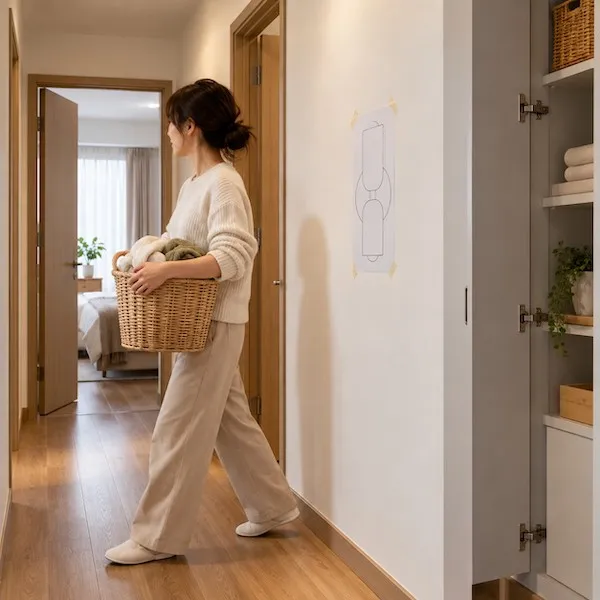
Step 2: Judge Size with a Full-Scale Outline
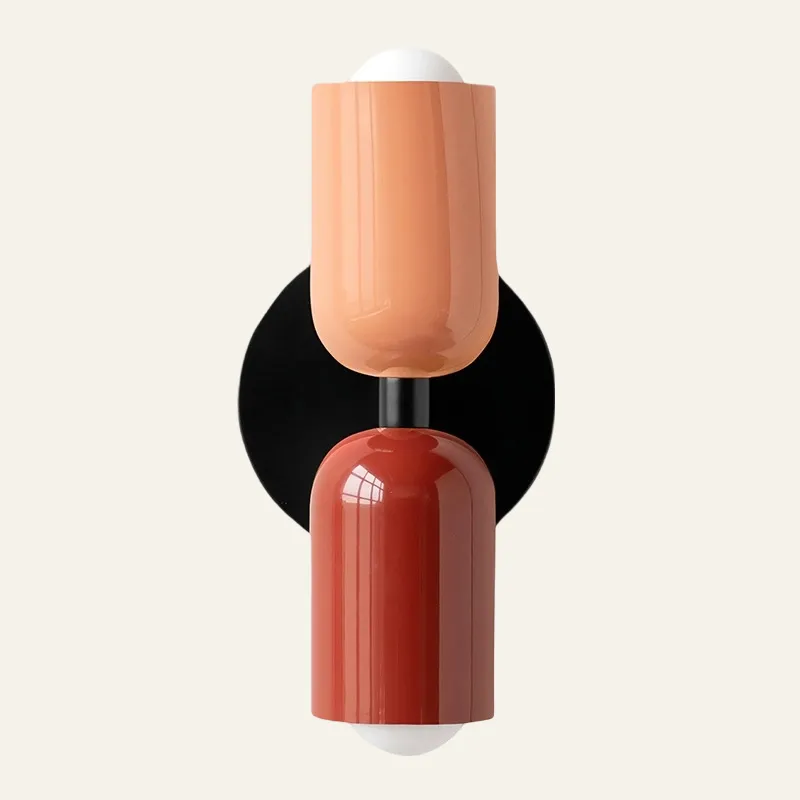
Copy the fixture's face dimensions onto paper or cardboard and tape the outline to the wall. The Symra N47 product page lists a diameter of 12 cm and a height of 28 cm, which makes a useful full-size outline. Its wall projection is not clearly listed, however, so confirm that measurement separately before ordering.
Stand at the entrance and halfway along the corridor. The outline should feel connected to nearby doors or panelling without competing with them. In a short hall, one well-placed light can be calmer than a pair. In a long hall, a compact form is easier to repeat.
Compare the Symra N47 dimensions with your paper outline before choosing a finish.
Step 3: Space by Wall Bays, Not by One Formula
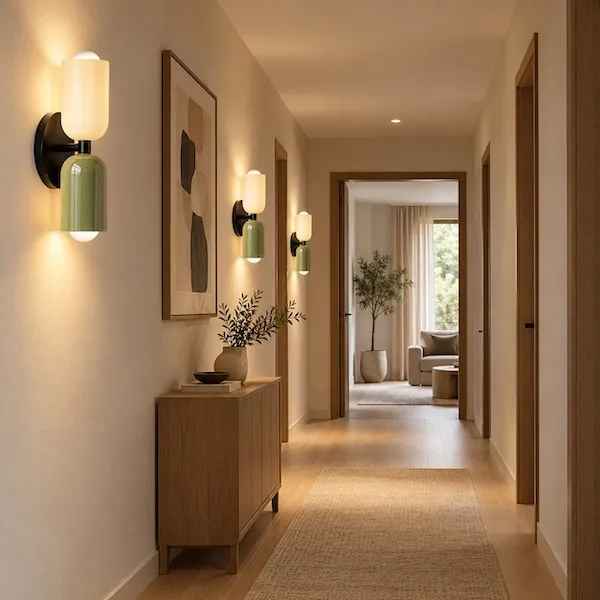
Divide the hallway into visual bays: the uninterrupted wall between a corner and a door, between two openings, or beside a console. Set the first and last light in each bay, then divide the remaining space into equal centre-to-centre intervals. Reset the rhythm after a turn or major opening instead of forcing one measurement through the whole corridor.
For a short bay, centre one fixture on the usable wall. For a long bay, repeat the same fixture and keep the end gaps visibly intentional. Tape every centre first, switch on nearby lights after dark, and look for dead patches or crowded pools before wiring.
Beam shape changes the spacing decision. Read our guide to up-and-down wall lights and indoor beam effects before finalising the centres.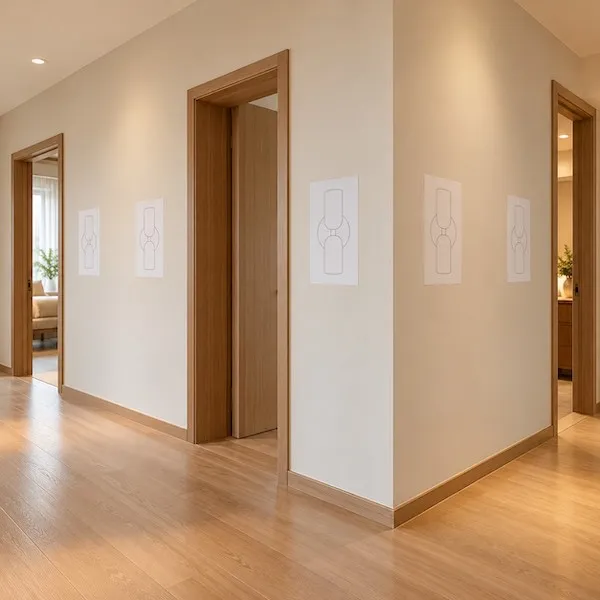
Step 4: Set Height by Sightline and Glare
There is no single correct height for every ceiling and household. Mark the fixture centre near the standing eye-line zone, then walk toward it from both directions. Move the outline until the brightest opening is not aimed straight at the eyes and the fixture still relates to door heads, moulding, and artwork.
This is a visual comfort test, not a code measurement. The Canadian Centre for Occupational Health and Safety offers useful general guidance on lighting, glare and fixture distribution: good visibility depends on appropriate light without troublesome glare or shadows. In a hallway, also test the view from a stair landing and from a child's or seated person's lower eye level.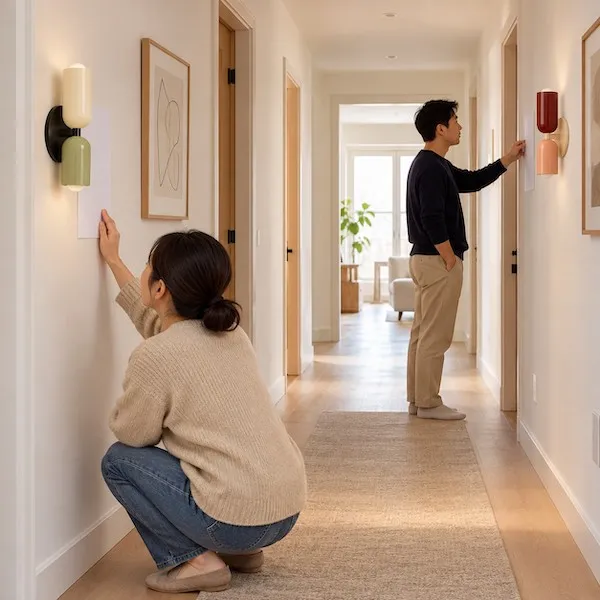
Step 5: Match the Lamp, Control, and Wiring
Do not choose the wall light without choosing the light source. Symra is listed for an E27 lamp at 8W, and the bulb is not included. The page also lists simple on-off control as non-dimmable, so do not assume that fitting a dimmable E27 bulb will make the complete installation dimmable.
Compare the bulb's luminous flux, colour temperature, cap type, and energy use rather than shopping by watts alone. The European Commission guidance on light-source labels and EPREL data explains where European buyers can check those model details.
Plan wiring before buying multiples. In England, Approved Document P for electrical safety in dwellings covers design, installation, inspection, testing, and when work must be notified. Requirements differ elsewhere, so confirm local rules and installer needs before opening the wall.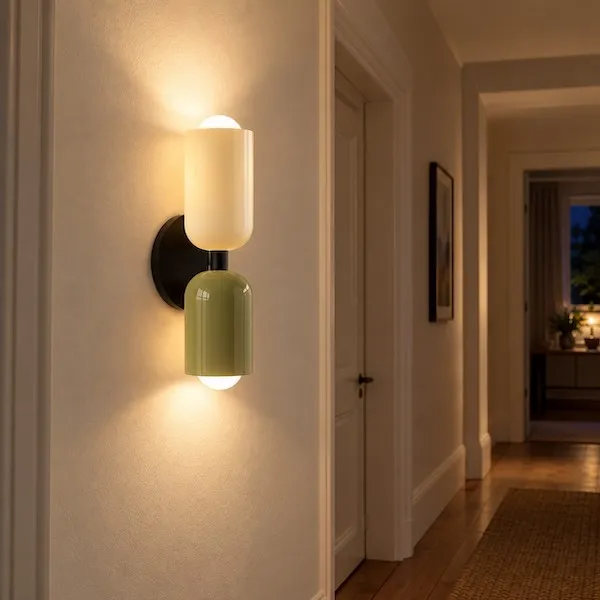
Check Symra N47's E27, 8W, and non-dimmable listing against your intended switch and bulb.
When Symra N47 Fits the Hallway
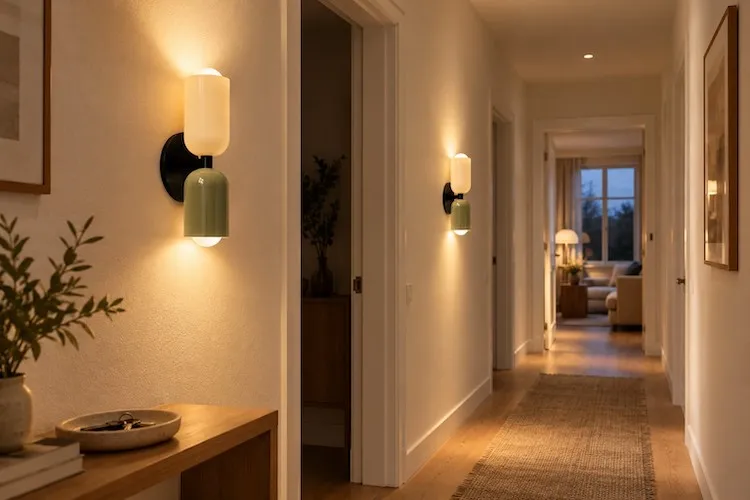
Symra makes sense when you want a compact, decorative metal-and-glass wall light with light directed above and below the fixture. Its 12 x 28 cm listed face size can suit repeated positions, while the colour options let it act as a quiet accent or a stronger graphic detail.
It is not the automatic answer for every passage. Choose a ceiling or indirect solution when wall projection cannot be confirmed, walls are already crowded, or the beam would meet mirrors and glossy art at an uncomfortable angle. If the project continues into a lounge, use the separate guide to Scandinavian wall lights for living rooms rather than applying corridor spacing to a seating area.
Final Hallway Checklist
- Measure the route, openings, and actual fixture projection.
- Tape up a full-size outline at every proposed centre.
- Space within clear wall bays and reset after major openings.
- Walk both directions and check glare after dark.
- Confirm lamp, control, wiring, and local installation rules.
- Order only after the layout still works with doors, art, and furniture.
Hallway Wall Light FAQs
How high should modern hallway wall lights be?
Use standing eye line as a mock-up zone, then adjust for glare, ceiling height, doors, and trim. The best point is comfortable from both walking directions.
How should I space sconces around doors?
Treat each uninterrupted wall section as its own bay. Centre one light in a short bay or divide a long bay evenly, then reset after the doorway.
Should sconces go on one wall or both?
One clear wall often looks calmer in a narrow corridor. Use both sides only when clearance, beam coverage, and architecture support a balanced layout.
Are wall lights suitable for a very narrow hallway?
Only when verified projection leaves a comfortable route. Test a full-size side profile, open every door, and walk past it carrying everyday items.
Can sconces replace the hallway ceiling light?
Sometimes, but do not assume they will. Test corners, thresholds, stairs, and floor visibility; add another light layer if wall lights leave dark zones.