European living-room buying guide
Best Scandinavian Wall Lights for Living Rooms: A Buyer's Guide
The best Scandinavian wall lights are not simply the palest or most minimal fittings. They give one part of the living room a clear job, sit comfortably in the sightline and use a bulb and beam that support how the room is actually used. Start with the wall and the activity; choose the silhouette last.
The Shortlist Starts with the Wall, Not the Trend
A good shortlist answers five questions: Is the light for background glow, reading or a focal wall? Will one fitting or a pair look calmer? Is the source hidden from seated eyes? Can the wall show the beam without curtains, shelves or art cutting through it? Do the bulb, switch and connection match the way you want to control the room?
If any answer is unclear, tape a paper outline to the wall and test it by day and after dark. This ten-minute mock-up reveals scale, reflections and visual crowding more reliably than a product image viewed in isolation.
Choose the Light Job Before the Shape
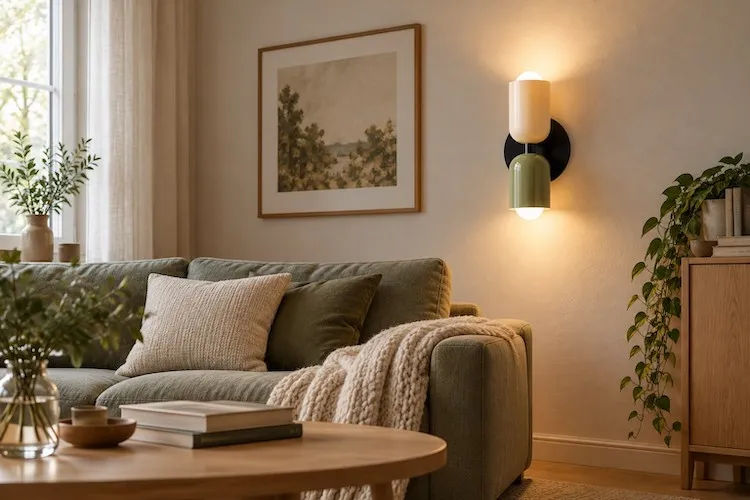
For background depth, choose a restrained wall-wash or up-and-down fitting on a clear surface. It should reveal the wall without pretending to be the room's main task light. For reading, use a fitting that directs useful light towards the page and can be reached from the seat. For a focal wall, let either the fixture or the beam lead; making both highly decorative can compete with artwork and furniture.
One light can anchor a reading corner or an asymmetric sofa layout. A pair suits a genuinely balanced wall, but it is not automatically more Scandinavian. Keep enough empty wall around each fitting for the composition to breathe. When the beam itself is the deciding feature, compare how up-and-down wall lights shape an indoor wall before choosing the body.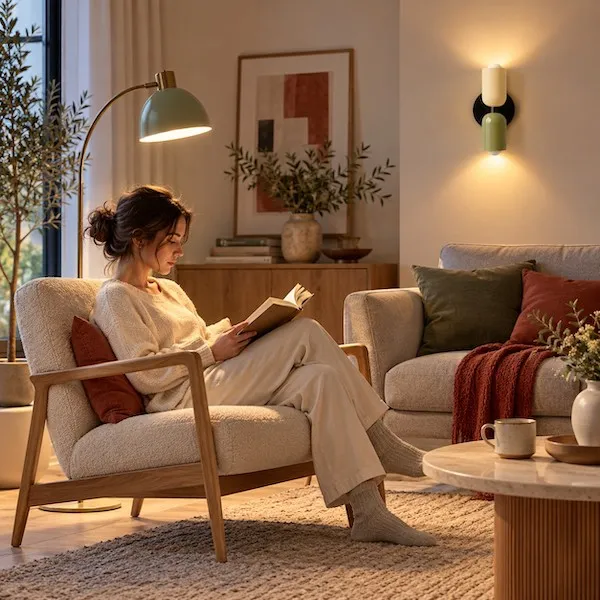
Measure What the Living Room Will Actually Show
Measure the fixture, then test its visual footprint. Mark its full height and width with removable paper, sit in every regular seat and enter through the main doorway. Check whether the lamp crowds the sofa, clips a curtain line, reflects in glass or exposes a bright source near eye level. For a pair, mock up both fittings; doubling a compact shape can still overwhelm a small wall.
Mounting height is a relationship, not a universal number. Use seated eyes, furniture, artwork and the visible beam as reference points. A corridor has different sightlines and repetition needs, so use the separate guide to modern wall-light size, spacing and placement for hallways rather than carrying a living-room layout into a passage.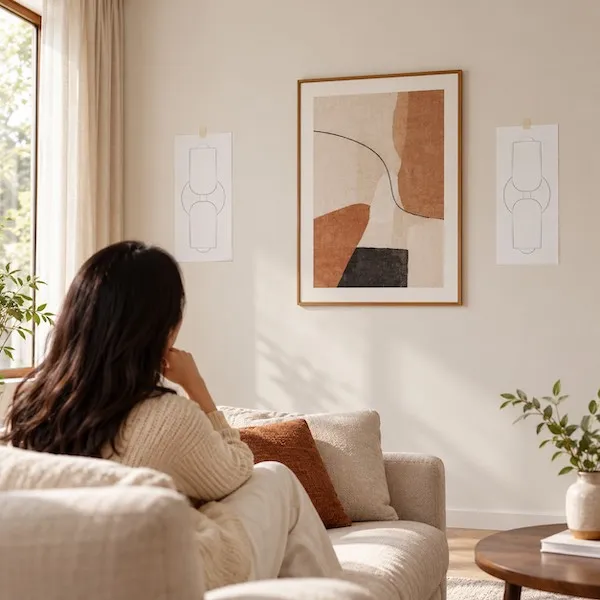
Buy the Bulb and Fixture as One System
For a replaceable bulb, the base only tells you what physically fits. Compare lumens for brightness, Kelvin for warmth, colour rendering for how furnishings look, and whether both lamp and control support dimming. The Energy Saving Trust's guidance on brightness, colour and dimmability explains that lumens, not watts, measure brightness and places 2700-3000K in the warm-white range commonly suited to homes.
This matters around a television: a visible source, a sharp reflection or a bright wall beside the screen can distract even when the fitting looks elegant while switched off. Test the proposed position from the main sofa at night. If the fixture is non-dimmable, choose its output carefully instead of assuming a dimmer can be added later.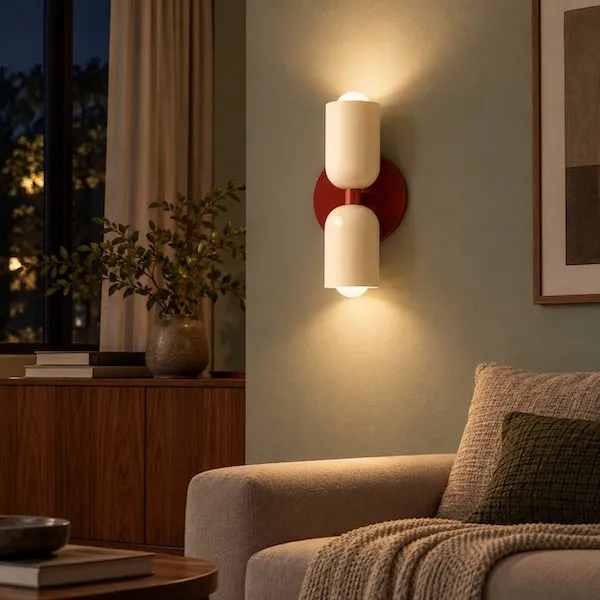
A European Check That Goes Beyond the Style
First, separate the luminaire from its light source. The European Commission's light-source guidance says the general energy label for luminaires was discontinued, while energy labelling applies to light sources; the EPREL record can include luminous flux, colour temperature and cap type. For a fitting sold without a bulb, inspect the bulb's label rather than expecting one on the decorative body.
Second, check conformity information without treating a logo as a guarantee of quality. The European Commission's explanation of CE marking says it is the manufacturer's declaration that applicable requirements are met, not an independent EU safety approval. Also confirm the seller's contact details, instructions, included parts, return terms and the exact electrical connection. Have a qualified local installer assess fixed wiring and the wall before holes are made.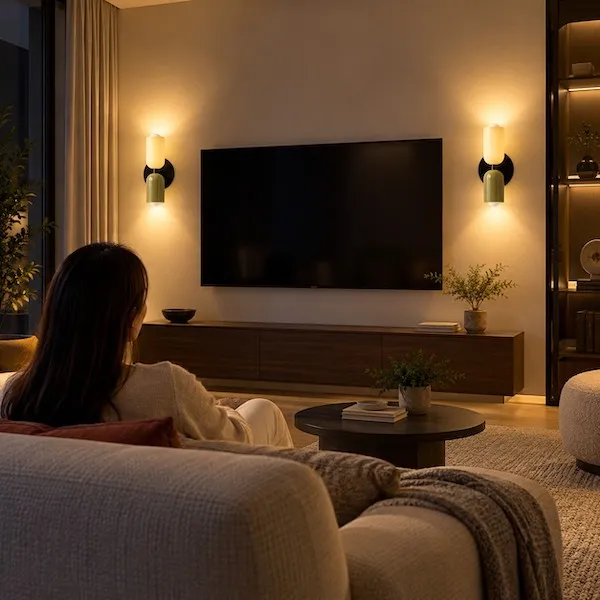
Where the Symra N47 Fits the Brief
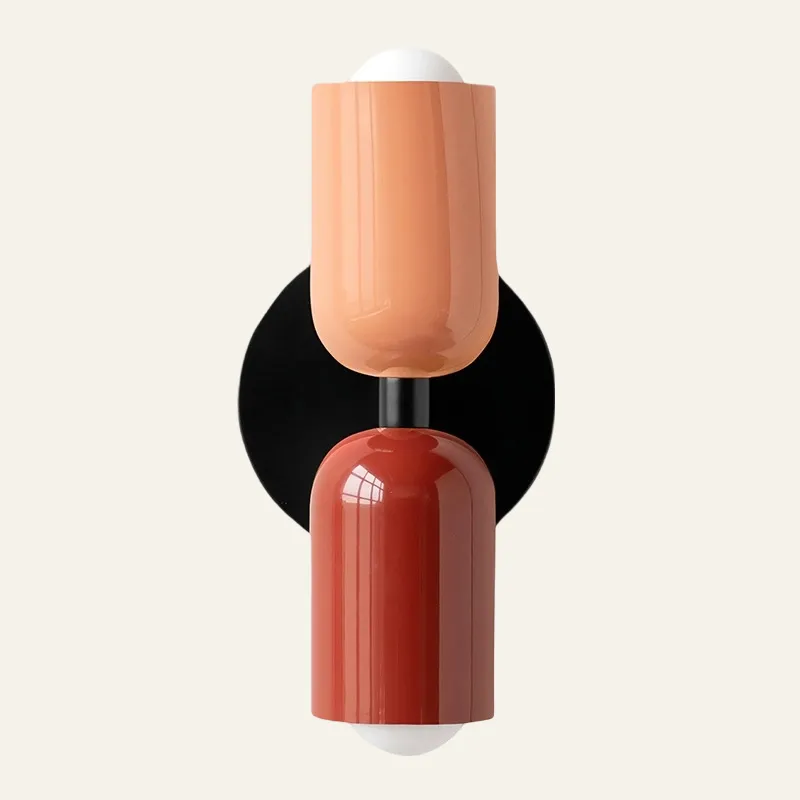
The Symra N47 is strongest as a compact decorative layer on a clear living-room wall. Its page describes an up-and-down double light and lists a 12-centimetre diameter, 28-centimetre height, 2-kilogram weight, E27 source, 8W power, non-dimmable operation and no included bulb. It also lists metal and glass with several finish and colour choices. Review Symra's verified dimensions and current options against your paper mock-up.
Choose it when you want a visible Scandinavian accent and a vertical glow beside a sofa, in a reading corner's background or on a quiet feature wall. Do not rely on it as the only reading light, and think carefully before placing its fixed output beside a television. The coloured combinations can be a controlled focal point; the quieter finishes integrate more easily with timber, wool, linen and pale walls.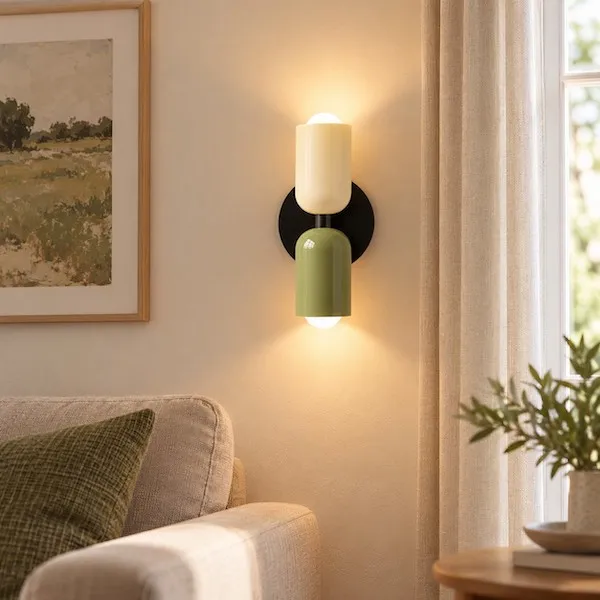
Four Mistakes That Make a Calm Wall Feel Busy
- Buying a pair by default: two fittings can crowd artwork or a short sofa wall when one would give the room a clearer centre.
- Choosing finish before beam: a beautiful body cannot correct glare, a blocked light pattern or the wrong lighting role.
- Matching every metal: Scandinavian rooms feel coherent through proportion and restraint, not through forcing every handle, frame and lamp into one finish.
- Ignoring the switched-off view: the fitting remains wall decor for most of the day, so judge its scale in daylight as carefully as its evening glow.
Scandinavian Wall Light FAQs
How do I know whether a Scandinavian wall light will suit my living room?
Mock up its outline, view it from the doorway and every seat, then check the lit beam at night. The right fitting supports the room's job and leaves visual breathing space.
Should I use one wall light or a pair above a sofa?
Use a pair only when the sofa wall is genuinely balanced and both fittings have clear space. One light often works better with off-centre art, a reading chair or an asymmetric layout.
Can wall lights go beside a television?
Yes, if neither the source nor its reflection sits in the viewing line. Test at night from the main seat and favour controllable, low-glare light.
Can I add wall lights without hardwiring?
Plug-in and rechargeable options exist, but cords and charging affect convenience. Confirm the exact connection before buying; the Symra page does not describe a plug-in cord.
Will Scandinavian wall lights look dated quickly?
Simple proportions and a useful lighting role tend to last better than a novelty shape. Choose the finish for the room you own, not for a temporary social-media palette.